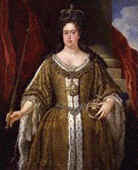
 Queen
Anne was the last of the Stuarts, the second daughter of James II
and
his first wife Ann Hyde.
Queen
Anne was the last of the Stuarts, the second daughter of James II
and
his first wife Ann Hyde.
She was shy,
conscientious, stout, gouty, shortsighted and very small.
Anne was 'homely',
and she did not have a particularly happy married life. Her husband,
Prince George of Denmark, was a drunk and a crashing bore!
Prince George was a
gross, rather ridiculous figure, even King James, Anne's father,
remarked "I have tried him drunk and I've tried him sober, but
there is nothing in him".
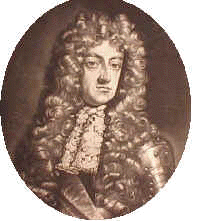 Anne
never enjoyed good health, and the almost constant pregnancies that
ended in miscarriages did not help. She became pregnant 17 times, but
only one child lived, William, who became the Duke of Gloucester.
Unfortunately he died aged 11, it is thought of hydrocephalus.
Anne
never enjoyed good health, and the almost constant pregnancies that
ended in miscarriages did not help. She became pregnant 17 times, but
only one child lived, William, who became the Duke of Gloucester.
Unfortunately he died aged 11, it is thought of hydrocephalus.
Anne was 37 years old
when she became queen in 1702, and at her coronation she was suffering
from a bad attack of gout, and had to be carried to the ceremony in an
open sedan chair with a low back, so that her six-yard train could pass
to her ladies walking behind.
Her closest friend
was Sarah Jennings, who was later to become the Duchess of Marlborough
when her husband, John Churchill, was made Duke of Marlborough after his
great victories over the French.
The friendship
between Anne and Sarah Churchill is well documented. They were
inseparable, and when they were apart they corresponded using 'fanciful'
names. Sarah was Mrs Freeman and Anne, Mrs Morley.
They had been very
close friends for many years before Anne became queen.
Lady Clarendon, who
was Anne's first Lady of the Bedchamber, said Sarah 'looked like a mad
women and talked like a scholar'.
Later, Sarah was to
be supplanted in Anne's affections by a cousin of hers, Abigail Hill.
She had caught the Queen's attention during Sarah's frequent absences
from Court, and Sarah was never again to be the Queen's closest
confidant.
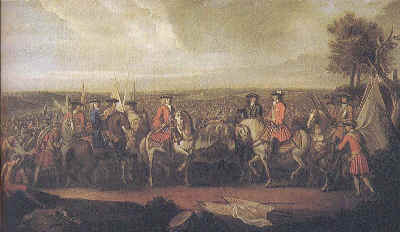
John Churchill, the
Duke of Marlborough was one of England's greatest soldiers, a brilliant
exponent of the use of mobility and firepower in the field.
The story goes that
the queen was playing dominoes at Windsor when a Colonel Parke brought
her a momentous message from the Duke of Marlborough.
It was addressed to
Sarah, and was written on the back of a tavern bill…it read 'I have
not time to say more, but I beg you will give my duty to the Queen and
let her know that her army has had a glorious victory'. The glorious
victory was over the French, and the battle was Blenheim!!
The Queen with tears
running down her cheeks gave Parke a miniature of herself, and a
thousand guineas in reward.
The year was 1704,
and in 1706 there was another great victory at Ramillies, followed by
another at Oudenarde in 1708, and at Malplaquet in 1709.
To show the country's
appreciation, Anne and Parliament gave the Duke of Marlborough land at
Woodstock in Oxfordshire, and built him a magnificent house, designed by
Vanburgh, called Blenheim Palace. Several centuries later another famous
member of the Churchill family, Winston Spencer Churchill was born there
in 1874.
In 1704 the English
captured Gibraltar
and the Treaty of Utrecht in 1713 ensured that England had a permanent
foothold on the Spanish mainland.
The reign of Queen
Anne was a brilliant one …and one which included many exceptionally
talented men - Swift, Pope, Addison and Steele were writing prose and
verse, Sir Christopher Wren was finishing the building of St. Paul's
Cathedral and Locke and Newton were propounding their new theories.
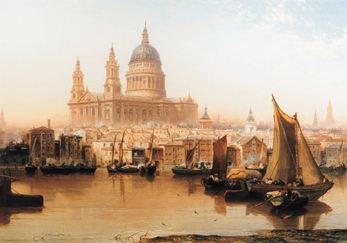
The United Kingdom of
Great Britain was created during her reign by the Union of England and
Scotland.
Anne herself created
'Queen Anne's Bounty' which restored to the Church an increase in the
incomes of the poorer clergy, a fund raised from the tithes which Henry
VIII had taken for his own use.
Queen Anne died on
Sunday 1st August 1714, she was 49. The possible cause of her
death was Erysipelas and suppressed gout.
Poor Queen Anne, her
name is not as revered as other Queens of England, she seemed to lack
the charisma of Elizabeth I, Mary I and Victoria, and yet in her reign
great deeds were done!
In her reign Britain
became a major military power on land, and the country became a firm
base for the 18th century's Golden Age.