|
There
have been 66 monarchs in England spread over a period of 1500 years.
|
EGBERT 827 - 839
Egbert was the first monarch to establish a stable and extensive rule over
Anglo-Saxon England. He is buried at Winchester.
|
AETHELWULF 839-858 - son
of
EGBERT
|
AETHELBALD
858 - 860
ETHELBERT 858 - 865
ETHELRED 865 - 871
|
|
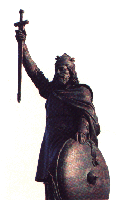
ALFRED
THE GREAT
871 - 899 -
Grandson
of Egbert
Born at Wantage, Oxfordshire around 849. Well educated, he is said to have
visited Rome on two occasions. Devout Christian and scholar. He was a fine
king, strong in battle against the Danes and a wise ruler, although
perhaps he is best known for "burning the cakes"! Began the
Anglo-Saxon Chronicles (detailing life between the 9th and 12th centuries)
Originated the Royal Navy.
|
EDWARD
(The Elder) 899 - 924
Son of Alfred. Retook the northern counties from the Danes
|
ATHELSTAN
924 - 939
|
EDMUND
939 - 946
Assassinated
(stabbed by a robber) in his hall whilst celebrating the feast of
Augustine
|
EADRED
946 - 955
|
EADWIG
955 - 959
|
EDGAR
959 - 975
|
 |
EDWARD
THE MARTYR 975 - 978
Assassinated by
followers of his brother, ETHELRED
at Corfe Castle, aged about 15yrs old
|
ETHELRED
II THE UNREADY 978 - 1016
Unable to organize
resistance against the Danes hence his nickname 'unready'. Became
King aged about 10, fled to Normandy in 1013 when Sweyn, King of the Danes
had over-run the country. Returned after Sweyn was killed by a fall from
his horse.
|
EDMUND
IRONSIDE 1016 - 1016
Son
of Ethelred.
Made
a pact with Canute to
divide England, but died soon afterwards.
|
CANUTE
(CNUT) THE DANE 1017 - 1035
Son of
Sweyn, he ruled well and with fairness. Well known for trying to control
the power of the sea. Divided England into four earldoms.
|
HAROLD
I 1035 - 1040
Son of Canute
|
HARDICANUTE
1040 - 1042
Son of Canute. Died drunk,
aged 24
|
 EDWARD
THE CONFESSOR
1042-1066 EDWARD
THE CONFESSOR
1042-1066
Founded
Westminster Abbey - died eight days after building work on the Abbey
finished.
|
HAROLD
II 1066
Defeated the
Norwegians at the battle of Stamford Bridge in Yorkshire, then marched
south to confront William of Normandy who had landed in Sussex. The
death of Harold at the Battle Of Hastings meant the end of the English
Saxon kings and the beginning of the Normans
|
NORMAN
KINGS
|
WILLIAM
I (The Conqueror)
1066- 1087
Also
known as William the Bastard (but not to his face!) reigned from 1066-87.
William came to England from Normandy and beat Harold at the Battle of Hastings in 1066. In 1085 the Doomsday Survey was begun
and all England was recorded so William knew exactly what his new kingdom
contained. He also created The New Forest as a Game Park for hunting.
|
WILLIAM
II
(Rufus) 1087- 1100
William
was not a popular king. He never married and was killed in the New Forest
by a stray arrow while out hunting, maybe accidentally, there is some
doubt about this. The Rufus Stone in The New Forest marks the spot
where he fell.
|
 HENRY
I 1100-1135 HENRY
I 1100-1135
Henry was the
fourth son of William I. His two sons were drowned so his daughter Matilda
was made his successor. She was married to Geoffrey Plantagenet.
When Henry died the Council considered a woman unfit to rule so offered
the throne to Stephen, a grandson of William
I.
|
STEPHEN
1135-1154
Stephen
was a very weak king and the whole country was almost destroyed by the
constant raids by the Scots and the Welsh. A decade of civil war ensued
when Matilda invaded from Anjou. A compromise was decided, Matilda's son
was to be king when Stephen died.
|
PLANTAGENET
KINGS
|
HENRY
II 1154-1189
Henry
was a strong king. He laid the foundation of the English Jury System and
raised new taxes from the landholders to pay for a militia
force. Henry is mostly remembered for his quarrel with Thomas A
Becket, and Becket's subsequent murder in Canterbury Cathedral on 29th
December 1170.
|
RICHARD
I
(The Lionheart) 1189 - 1199
Richard
was the second son of Henry II. He was thought to be homosexual. He spent
almost all of his reign abroad, fighting in the Third Crusade. He had no
children.
|
JOHN
1199 -1216
John
was the fourth child of Henry II. He was cruel and avaricious and
the raising of
punitive taxes united all the elements of society, clerical
and lay, against him. On 15th June 1215 at Runnymede the barons compelled
John to sign Magna Carta, the Great Charter, which reinstated the rights
of all his subjects.
|
HENRY
III 1216 -1272
Henry
was 9 years old when he became king. He was a weak man, easily influenced
by his wife's French relations. In 1264 Henry was captured during a civil
war and was forced to set up a 'Parlement' at Westminster, the start of
the House of Commons. Henry was the greatest of all patrons of medieval
architecture.
|
EDWARD
I 1272 - 1307
Edward
was a statesman, lawyer and soldier. He formed the Model Parliament
in 1295, bringing together the knights, clergy, nobility and burgesses of
the cities, bringing Lords and Commons together for the first time. He
created his eldest son Prince of Wales but was unable to conquer the
Scots.
|
EDWARD
II 1307 - deposed 1327
Edward
was a weak and perverted king. He had many 'favorites', Piers Gaveston
being the most notorious. He was beaten by the Scots at the Battle of
Bannockburn in 1314. Edward was deposed and held captive in Berkeley
Castle in Gloucestershire. He was murdered, so legend has it, by
having a red-hot poker thrust up his anus!
|
EDWARD
III 1327 - 1377
Son
of Edward II, he reigned for 50 years. The Hundred Years War with
France started in 1338, and he won two great victories, Crecy ands
Poitiers. The outbreak of bubonic plague, the 'Black Death' in 1348-1350
killed half the population of England.
|
RICHARD
II 1377 - deposed 1399
He
was extravagant, unjust and faithless. In 1381 came the Peasants Revolt,
led by Wat Tyler. It was put down with great severity. In 1399 Henry of
Lancaster returned from exile and deposed Richard, becoming elected King
Henry IV. Richard was murdered in prison in 1400.
|
HOUSE
OF LANCASTER
|
HENRY
IV 1399 - 1413
Henry's
reign was one of rebellions. Richard's half brothers rose
immediately on his behalf and in Wales, Owen Glendower led a national
uprising that was not finally quelled until 1410. Henry, the first
Lancastrian king, died of leprosy in 1413.
|
HENRY
V 1413 - 1422
Henry
was a pious, stern and skilful soldier. he renewed the war with
France and in the face of tremendous odds beat the French at the battle of
Agincourt in 1415. His wife Catherine was the daughter of the
lunatic king of France.
|
HENRY
VI 1422 - deposed 1461
Beginning of the Wars of the Roses
Gentle
and retiring, he inherited a losing war with France. In 1454 the king
succumbed to the madness that was hereditary in his mother's family.
The battle of St Albans in 1458 between the Lancastrians and Yorkists, was
won by the Yorkists. Henry's son, Edward was killed at Tewkesbury. Henry
was also killed after the battle, by Richard Duke of Gloucester.
|
HOUSE
OF YORK
|
EDWARD
IV 1461- 1483
He
was a son of Richard Duke of York and not a popular king. His morals
were poor and even his contemporaries disapproved of him. During his
reign the first printing press was established in Westminster by William
Caxton.
|
EDWARD
V 1483 - 1483
Reigned
for only two months. Elder son of Edward IV.
He and his brother Richard were murdered in the Tower of London on the
orders of his uncle Richard Duke of Gloucester.
|
RICHARD
III 1483 - 1485 End of the Wars of
the Roses
Brother
of Edward IV. The murders of his nephews and
the ruthless extinction of all those who opposed him made his rule very
unpopular. In 1485 Henry Richmond, descendant of John of Gaunt, father of
Henry IV, landed in west Wales, gathering forces as he marched into
England. At Market Bosworth in Leicestershire he defeated and killed
Richard in what was to be the last important battle in the Wars of the
Roses.
|
THE
TUDORS
|
HENRY
VII 1485 - 1509
Henry
was the first Tudor king. he married Elizabeth of York and so united
the two warring houses, York and Lancaster. He was a skilful
politician but avaricious. The material wealth of the country
increased greatly. During Henry's reign playing cards were invented and
the portrait of his wife Elizabeth has appeared eight times on every pack
of cards for nearly 500 years.
|
HENRY
VIII 1509 - 1547
The best
known fact about Henry VIII is that he had six wives! Most school children
learn the following rhyme to help them remember the fate of each wife:
"Divorced, Beheaded, Died: Divorced, Beheaded, Survived". His
first wife was Catherine of Aragon, his brothers widow, whom he later
divorced to marry Anne Boleyn. This
divorce caused the split from Rome and Henry declared himself the head of
the Church Of England. The Dissolution of the Monasteries began in
1536, and the money gained from this helped Henry to bring about an
effective Navy. In an effort to have a son, Henry married four
further wives, but only one son was born, to Jane Seymour. Henry had
two daughters both to become rulers of England - Mary, daughter of
Catherine of Aragon, and Elizabeth, daughter of Anne Boleyn.
|
EDWARD
VI 1547 -
1553
Timeline 1547-1558
Edward
was a sickly boy; he had, it is thought, tuberculosis. Even though his
reign was short, many men made their mark. Cranmer wrote the Book of
Common Prayer and the uniformity of worship helped turn England into a
Protestant State.
After Edward's
death there was a dispute over the succession. As Mary was Catholic,
Lady Jane Gray was named as the next in line to the throne. She was proclaimed
Queen but Mary entered London with her supporters and Jane was taken to
the Tower. She reigned for only 9 days. She was executed in
1554, aged 17.
|
MARY
I (Bloody Mary) 1553 - 1558
Daughter
of Henry VIII and Catherine of Aragon. A
devout Catholic, she married Philip of Spain. Mary attempted to
enforce the wholesale conversion of England to Catholicism. She carried
this out with the utmost severity. The Protestant bishops, Latimer,
Ridley and Archbishop Cranmer were among those burnt at the stake.
The place, in Broad Street Oxford, is marked by a bronze cross. The
country was plunged into a bitter blood bath, which is why she is
remembered as Bloody Mary. She died in 1558 at Lambeth Palace.
|
ELIZABETH
I
1558-1603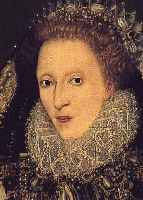 Timeline
1558-1603
Timeline
1558-1603
A remarkable
woman, she was noted for her learning and wisdom. From first to last
she was popular with the people and had a genius for the selection of
capable advisors. Drake, Raleigh, Hawkins, the Cecils, Essex and
many many more made England respected and feared. The Spanish Armada
was decisively defeated in 1588 and Raleigh's first Virginian colony was
founded. The execution of Mary Queen of Scots marred what was a
glorious time in English history. Shakespeare was also at the height
of his popularity. Elizabeth never married.
|
THE
STUARTS
|
JAMES
I and VI of Scotland 1603 -1625
James
was the son of Mary Queen of Scots and Lord Darnley. He was the first king
to rule over Scotland and England. James was more of a scholar than a man
of action. In 1605 the Gunpowder Plot was hatched: Guy Fawkes and his
friends, Catholics, tried to blow up the Houses of Parliament, but were
captured before they could do so. James's reign saw the publication
of the Authorized Version of the Bible, though this caused problems with
the Puritans and their attitude towards the established church. In
1620 the Pilgrim Fathers sailed for America in their ship The Mayflower.
|
CHARLES
1 1625 - 1649 English Civil War
 Son of
James I, Charles believed that he ruled by Divine Right. He encountered
difficulties with Parliament from the beginning, and this led to the
outbreak of Civil War in 1642. The war lasted four years and after
the defeat of Charles by the New Model Army, led by Oliver Cromwell,
Charles was captured and executed at Whitehall in 1649. Son of
James I, Charles believed that he ruled by Divine Right. He encountered
difficulties with Parliament from the beginning, and this led to the
outbreak of Civil War in 1642. The war lasted four years and after
the defeat of Charles by the New Model Army, led by Oliver Cromwell,
Charles was captured and executed at Whitehall in 1649.
|
THE
COMMONWEALTH
declared May
19, 1649
|
OLIVER
CROMWELL, Lord Protector 1653 - 1658
Cromwell
was born at Huntingdon, north of Cambridge in 1599, the son of a small
landowner. He entered Parliament in 1629 and became active in events
leading to the Civil War. A leading Puritan figure, he raised
cavalry forces and organized the New Model Army, which he led to victory
over the Royalists at Naseby in 1645. Failing to gain agreement on
constitutional change in government with CHARLES I,
Cromwell was a member of a 'Special Commission' that tried and condemned
the King to death in 1649. Cromwell declared Britain a republic 'The
Commonwealth' and he went on to become it's Lord Protector.
Cromwell went
on to crush the Irish clans and the Scots loyal to CHARLES
II between 1649 and 1651. In 1653 he finally expelled the
corrupt English parliament and with the agreement of army leaders became
Lord Protector (King in all but name)
|
RICHARD
CROMWELL, Lord Protector 1658 - 1659
|
THE
RESTORATION
|
CHARLES
II 1660 - 1685
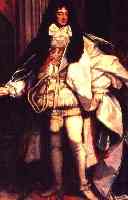 Son
of Charles I. Known as the Merry Monarch. After the collapse of the Protectorate following the death of
Oliver Cromwell and the flight of Richard Cromwell to France, the Army and
Parliament asked Charles to take the throne in 1660. Although very
popular he was a weak king and his foreign policy was inept.
He had 13 known mistresses, one of whom was Nell
Gwyn. He fathered numerous illegitimate children but no heir to
the throne. The Great Plague in 1665 and the Great Fire of London in
1666 took place during his reign. Many new buildings were built at
this time. St. Paul's Cathedral was built by Sir Christopher Wren
and also many churches still to be seen today. Son
of Charles I. Known as the Merry Monarch. After the collapse of the Protectorate following the death of
Oliver Cromwell and the flight of Richard Cromwell to France, the Army and
Parliament asked Charles to take the throne in 1660. Although very
popular he was a weak king and his foreign policy was inept.
He had 13 known mistresses, one of whom was Nell
Gwyn. He fathered numerous illegitimate children but no heir to
the throne. The Great Plague in 1665 and the Great Fire of London in
1666 took place during his reign. Many new buildings were built at
this time. St. Paul's Cathedral was built by Sir Christopher Wren
and also many churches still to be seen today.
|
JAMES
II
1685 - 1688
Brother
of Charles II. A Catholic, he was very
unpopular because of his persecution of the Protestants, and he was hated
by the people. Following the Monmouth uprising (Monmouth was an
illegitimate son of Charles II and a
Protestant) and the Bloody Assizes of Judge Jeffries, the Parliament asked
William of Orange to take the throne.
William was married to Mary, Jame's
sister. William landed in England and James fled to France.
|
WILLIAM
III 1689 - 1702
AND MARY II
1689 - 1694
William and Mary were to reign jointly, and William
was to have the Crown for life after Mary died in 1694. James
plotted to regain the throne and in 1689 landed in Ireland.
William defeated James at the Battle of the Boyne and James fled to
France once again.
|
QUEEN
ANNE
1702 - 1714
Anne
was the second daughter of James II. She had
17 children but all died. Anne was a close friend of Sarah
Churchill, the Duchess of Marlborough. Anne was a staunch, high
church Protestant and the victories of the Duke of Marlborough abroad gave
the country an influence never before attained in Europe.
After Anne's
death the succession went to the nearest Protestant relative of the Stuart
line. This was Sophia, daughter of Elizabeth of Bohemia, James
I only daughter.
|
THE
HANOVARIANS
|
GEORGE
I
1714 -1727
Son
of Sophia and the Elector of Hanover. George never learned English
so the conduct of national policy was left to the government of the time.
Sir Robert Walpole became England's first Prime Minister. In 1715
the Jacobites ( followers of James Stuart, son of James
II) attempted to supplant George, but the attempt failed. George
spent little time in England - he preferred his beloved Hanover.
|
GEORGE
II
1727 - 1760
Only
son of George I. He was more English than his
father, but still relied on Sir Robert Walpole to run the country.
George was the last English king to lead his army into battle at Dettingen
in 1743. In 1745 the Jacobites tried once again to restore a Stuart
to the throne. Prince Charles Edward Stuart, 'Bonnie Prince
Charlie'. landed in Scotland. He was routed at Culloden Moor by the army
under the Duke of Cumberland, known as 'Butcher' Cumberland. Bonnie
Prince Charlie escaped to France with the help of Flora MacDonald, and
finally died a drunkard's death in Rome.
|
GEORGE
III
1760 - 1820
He was a grandson of George II. His reign was
one of elegance and the age of some of the greatest names in English
literature - Jane Austen, Byron, Shelley, Keats and Wordsworth. It was
also the time of great statesmen like Pitt and Fox and great captains like
Wellington and Nelson. In 1773 the 'Boston Tea Party' was the first
sign of the troubles that were to come in America. The American
Colonies proclaimed their independence on July 4th 1776. George was
well meaning but suffered from a mental illness due to intermittent
porphyria and eventually became blind and insane. His son ruled as
Prince Regent after 1811 until George's death.
|
GEORGE
IV
1820 - 1830
Known
as the 'First Gentleman of Europe'. He had a love of art and architecture
but his private life was a mess, to put it mildly! He married twice,
once in 1785 to Mrs. Fitzherbert, secretly as she was a Catholic, and then
in 1795 to Caroline of Brunswick! Mrs. Fitzherbert remained the love of
his life. Caroline and George had one daughter Charlotte in 1796 but she
died in 1817. George was considered a great wit, but was also a
buffoon and his death was hailed with relief!
|
WILLIAM
IV
1830 - 1837
Known
as the 'Sailor King', he was the third son of George III. Before his accession he lived with a
Mrs. Jordan, an actress, by whom he had ten children. When Princess
Charlotte died, he had to marry in order to secure the succession.
He married Adelaide of Saxe-Coburg in 1818. He had two daughters but
they did not live. He hated pomp and wanted to dispense with the
Coronation. The people loved him because of his lack of pretension.
During his reign England abolished slavery in the colonies in 1833.
The Reform Act was passed in 1832, this extended the franchise to the
middle-classes on a basis of property qualifications.
|
VICTORIA
1837 - 1901
Victoria
was the only child of Princess Victoria of Saxe-Coburg and Edward Duke of
Kent, fourth son of George III. The throne
Victoria inherited was weak and unpopular. Her Hanovarian uncles had
been treated with irreverence. In 1840 she married her cousin Albert
of Saxe-Coburg. Albert exerted tremendous influence over the Queen and
until his death was virtual ruler of the country. He was a pillar of
respectability and left two legacies to England, the Christmas Tree and
the Great Exhibition of 1851. With the money from the Exhibition
several institutions were developed, the Victoria and Albert Museum, the
Science Museum, Imperial College and the Royal Albert Hall. The
Queen withdrew from public life after the death of Albert in 1861 until
her Golden Jubilee in 1887. Her reign saw the British Empire double in
size and in 1876 the Queen became Empress of India, the 'Jewel in the
Crown'.
When Victoria died in 1901, after the longest reign in English history,
the British Empire and British world power had reached their highest
point. She had six children, 40 grand-children and 37 great-grandchildren,
scattered all over Europe.
|
EDWARD
VII
1901 - 1910
A
much loved king, the opposite of his dour father. He loved
horse-racing, gambling and women! This Edwardian Age was one of
elegance. Edward had all the social graces and many sporting
interests, yachting and horse-racing - his horse Minoru won the Derby in
1909. Edward married the beautiful Alexandra of Denmark in 1863 and
they had six children. The eldest, Edward Duke of Clarence, died in
1892 just before he was to marry Princess Mary of Teck. When Edward
died in 1910 it is said that Queen Alexandra brought his current mistress
Mrs. Keppel to his bedside to take her farewell. His best known
mistress was Lily Langtry, the 'Jersey Lily'
|
HOUSE
OF WINDSOR
- Name changed in 1917
|
GEORGE
V 1910 - 1936
George
had not expected to be king, but when his elder brother died he became the
heir-apparent. He had joined the Navy as a cadet in 1877 and loved the
sea. He was a bluff, hearty man with a 'quarter-deck' manner. In
1893 he married Princess Mary of Teck, his dead brother's fiancée. His
years on the throne were difficult; the First World War in 1914 - 1918 and
the troubles in Ireland which lead to the creation of the Irish Free State
were considerable problems. In 1932 he began the royal broadcasts on
Christmas Day and in 1935 he celebrated his Silver Jubilee. His latter
years were overshadowed by his concern about the Prince of Wales and his
infatuation with Mrs. Simpson.
|
EDWARD
VIII
June 1936 - abdicated December 1936
Edward
was the most popular Prince of Wales England had ever had. Consequently
when he renounced the throne to marry Mrs. Wallis Simpson the country
found it almost impossible to believe. The people as a whole knew
nothing about Mrs. Simpson until early in December 1936. Mrs.
Simpson was an American, a divorcee and had two husbands still living.
This was unacceptable to the Church as Edward had stated that he wanted
her to be crowned with him at the Coronation to take place the following
May. Edward abdicated in favor of his brother and took the title,
Duke of Windsor. He went to live abroad.
|
GEORGE
VI 1936 - 1952
George
was a shy and nervous man with a very bad stutter, the exact opposite of
his brother the Duke of Windsor, but he had inherited the steady virtues
of his father George V. He was very popular
and well loved by the English people. The prestige of the throne was
low when he became king but his wife Elizabeth and his mother Queen Mary
were outstanding in their support of him.
The Second World War started in 1939 and throughout the King and Queen set
an example of courage and fortitude. They remained at Buckingham
Palace for the duration of the war in spite of the bombing. The
Palace was bombed more than once. The two Princesses, Elizabeth and
Margaret, spent the war years at Windsor Castle. George was in close touch
with the Prime Minister, Winston Churchill throughout the war and both had
to be dissuaded from landing with the troops in Normandy on D-Day!
The post-war years of his reign were ones of great social change and saw
the start of the National Health Service. The whole country flocked to the
Festival of Britain held in London in 1951, 100 years after the Great
Exhibition during Victoria's reign.
|
ELIZABETH
II 1952 -
|