The
Norman Conquest 1066
|
To understand who the Normans were, we have to go back a little to 911. In this year a rather large (reckoned to be so big that a horse could not carry him!) Viking chief called Rollo accepted the 'kind' offer of a large area of Northern France from the then king of France Charles II ('The Simple' ) as part of a peace treaty. Rollo and his 'Nor(th) Men' settled in this area of northern France now known as Normandy. Rollo became the first Duke of Normandy and over the next hundred years or so the Normans adopted the French language and culture.
In Normandy the current Duke William did not agree with the voting of the Witan. William claimed that years earlier, Edward had promised the crown of England to him. In addition, he believed that he had strengthened his claim still further when in 1063 he had tricked Harold into swearing to support his claim to the English throne. More than a little annoyed, William prepared to invade. King
Harold also had problems to the north of England - sibling
rivalry. Harold's brother Tostig had joined forces with Harold
Hardrada, King of Norway, and had landed with an army in Yorkshire.
Harold marched his own English army north from London to repel the
invaders. Arriving at Tadcaster on 24th September, he seized the
opportunity to catch the enemy off guard. His army was exhausted
after the forced march from London, but after a bitter, bloody battle to
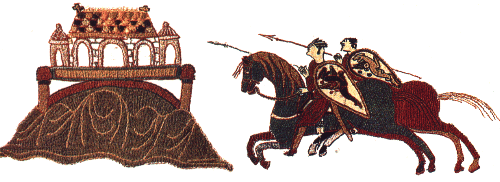
capture the bridge at Stamford, Harold won a decisive victory on 25th
September. Harold Hardrada and Tostig were both killed. On October 1st Harold and his depleted army then marched the three hundred kilometers south to do battle with Duke William of Normandy who had landed at Pevensey, Kent on the 28th September. Harold's
sick, exhausted Saxon army met William's fresh, rested Norman troops on
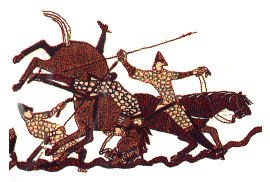
October 14th at Hastings, and the great battle began. At first,
the two-handed Saxon battleaxes sliced through the armor of the Norman
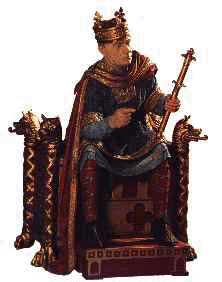
knights, but slowly the Normans began to gain control. William could truly now be called The Conqueror! On Christmas Day 1066 Archbishop Ealdred of York crowned William King of England. The early years of William's English rule were a little insecure. He built castles across England to convince all who was the boss, meeting force with even greater force as rebellious regions like Yorkshire were laid waste (the harrowing of theNorth). By around 1072 the Norman hold on the kingdom was firmly established. Normans controlled most major functions within the Church and the State. The Domesday Book exists today as a record, compiled some 20 years after the Battle of Hastings, showing all landholder's estates throughout England. It demonstrates the Norman genius for order and good government as well as showing the vast tracts of land acquired by the new Norman owners. Norman genius was also expressed in architecture. Saxon buildings had mostly been wooden structures; the French 'brickies' at once made a more permanent mark on the landscape. Massive stone castles, churches, cathedrals and monasteries were erected, these imposing structures again clearly demonstrating just who were now in charge. |
 On
the 5th January 1066,
On
the 5th January 1066, 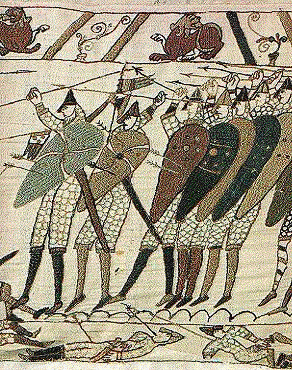
 King Harold was struck in the eye by a chance Norman arrow and was
killed but the battle raged on until all of Harold's loyal bodyguard
were slain.
King Harold was struck in the eye by a chance Norman arrow and was
killed but the battle raged on until all of Harold's loyal bodyguard
were slain.