The
people of London who had managed to survive the Great
Plague in 1665 must have thought that the year 1666 could only be
better, and couldn't possibly be worse!
Poor
souls…they could not have imagined the new disaster that was to befall
them in 1666.
A fire started on September 1st in the King's bakery in Pudding Lane near London Bridge. Fires were quite a common occurrence in those days and were soon quelled. Indeed, when the Lord Mayor of London, Sir Thomas Bloodworth was woken up to be told about the fire, he replied "Pish! A woman might piss it out!" . However that summer had been very hot and there had been no rain for weeks, so consequently the wooden houses and buildings were tinder dry.
 The
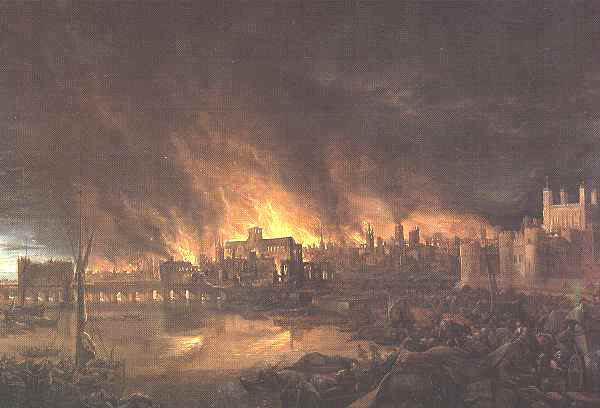
fire soon took hold and by the 2nd September, 300 houses had collapsed
and the strong east wind spread the flames further, jumping from house
to house. The fire soon swept through the warren of streets lined with
houses, the upper stories of which almost touched across the narrow
winding lanes. Efforts to bring the fire under control by using buckets
quickly failed. Panic began to spread through the city.
The
fire soon took hold and by the 2nd September, 300 houses had collapsed
and the strong east wind spread the flames further, jumping from house
to house. The fire soon swept through the warren of streets lined with
houses, the upper stories of which almost touched across the narrow
winding lanes. Efforts to bring the fire under control by using buckets
quickly failed. Panic began to spread through the city.
As
the fire raged on, people tried to leave the city and poured down to the
River Thames in an attempt to escape by boat.
Absolute
chaos reigned as, as often happens today, thousands of 'sightseers' from
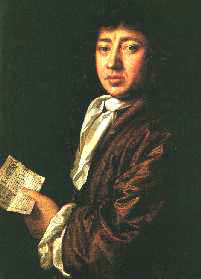
the villages came to view the disaster. Samuel Pepys and John
Evelyn, the diarists, both gave dramatic, first-hand accounts of the
next few days. Samuel Pepys, who was a clerk of the Privy Seal,
hurried off to inform King Charles
II. The King immediately
ordered that all the houses in the path of the fire should be pulled
down to create a 'fire-break'. This was done with hooked poles, but to
no avail as the fire outstripped them!
By the 4th September half of London was in flames! The King himself joined the fire fighters, passing buckets of water to them in an attempt to quell the flames, but the fire raged on.
As a
last resort gunpowder was used to blow-up houses that lay in the path of
the fire, and so create an even bigger fire-break, but the sound of the
explosions started rumors that a French Invasion was taking place!….
Even more panic!!
As
refugees poured out of the city, St. Paul's Cathedral was caught in the
flames. The acres of lead on the roof melted and poured down on to the
street like a river, and the great cathedral collapsed. Luckily the
Tower of London escaped the inferno, and eventually the fire was brought
under control, and by the 6th September had been extinguished
altogether.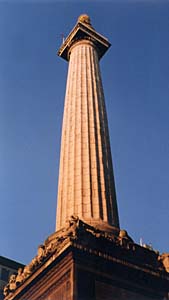
Only
one fifth of London was left standing!!
Hundreds
of thousands of people were left homeless. Eighty-nine parish churches,
the Guildhall, numerous other public buildings, jails, markets and
fifty-seven halls were now just burnt-out shells. The loss of property
was estimated at £5 to £7 million. King Charles gave the fire fighters
a generous purse of 100 guineas to share between them. Not for the last
time would a nation honor its brave fire fighters.
In
the immediate aftermath of the fire a poor, demented French watchmaker
called (Lucky) Hubert, confessed to starting the fire
deliberately, justice was swift and he was rapidly hanged. It was
sometime later however, that it was realized that he couldn't have
started it, as he was not in England at the time!
 Although
the Great Fire was a catastrophe it did cleanse the city. The
overcrowded and plague ridden streets were destroyed and a new London
emerged. A monument was erected in Pudding Lane on the spot where the
fire began, and can be seen today, where it is a reminder of those
terrible days in September 1666.
Although
the Great Fire was a catastrophe it did cleanse the city. The
overcrowded and plague ridden streets were destroyed and a new London
emerged. A monument was erected in Pudding Lane on the spot where the
fire began, and can be seen today, where it is a reminder of those
terrible days in September 1666.
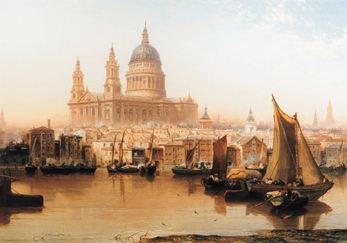
Sir
Christopher Wren was given the
task of re-building London, and his masterpiece; St. Paul's Cathedral
was started in 1675 and completed in 1711. In memory of Sir
Christopher there is an inscription in the Cathedral, which reads,
"Si Monumentum Requiris Circumspice". - "If you seek his
monument, look round". Wren also rebuilt 52 of the City
Churches and his work turned the City of London into the city we know
today, so perhaps The Great Fire wasn't such a terrible disaster after
all.