|
 After
they invaded Britain in AD 43, the Romans quickly established
control over southern England. The conquest of the 'wild
barbarians' in the North however was not going to be so easy. After
they invaded Britain in AD 43, the Romans quickly established
control over southern England. The conquest of the 'wild
barbarians' in the North however was not going to be so easy.
In the AD 70's and 80's the Roman commander Agricola led a
series of major assaults on the barbarian tribes of northern
England and the Scottish lowlands. Despite a successful campaign
into Scotland, the Romans failed in the long term to hold
on to any lands gained. Forts and signal posts were built
back in the lowlands linked by the Stanegate road which ran from
the waters of the Tyne in the East to the Solway estuary in the
West.
Some four decades later in around AD 122, with the barbarians
still untamed, these lowland forts were again under intense
hostile pressure. A visit by the Emperor Hadrian that year to
review the border problems at the boundaries of his empire led
to a more radical solution. He ordered the building of an
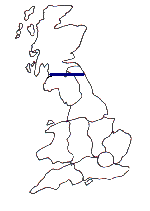
immense barrier stretching over eighty Roman miles from the west
coast of Britain to the east. Built of stone in the east
and initially of turf in the west (because lime for mortar was
not available) Hadrian's Wall took at least six years to
complete.
Approximately 10ft (3m) in width and 15ft (4.6m) in height,
with a parapet on the north side giving an overall height of
20ft (6m), to potential invaders the structure emphasized the
power and might of Rome. As if to reinforce this, 80
milecastles are spaced one Roman mile apart along it's entire
length.
 By
AD 138 the Romans, perhaps with a few scores to settle, again
sought to civilize the northerners with a new campaign into
Scotland. This time a new frontier, the Antonine Wall, was
rapidly established between the Forth and Clyde rivers and
Hadrian's Wall was promptly abandoned. By about AD160 however
the Romans were again persuaded by the Scots that they did not
wish to be civilized and were forced to relocate back to
Hadrian's Wall. So concerned about the reception they had
received in the north, the Romans undertook to replace the
remaining stretch of turf wall with a more substantial stone
structure. By
AD 138 the Romans, perhaps with a few scores to settle, again
sought to civilize the northerners with a new campaign into
Scotland. This time a new frontier, the Antonine Wall, was
rapidly established between the Forth and Clyde rivers and
Hadrian's Wall was promptly abandoned. By about AD160 however
the Romans were again persuaded by the Scots that they did not
wish to be civilized and were forced to relocate back to
Hadrian's Wall. So concerned about the reception they had
received in the north, the Romans undertook to replace the
remaining stretch of turf wall with a more substantial stone
structure.
The Romans maintained and occupied the Wall into the fourth
century AD, resisting several further barbarian raids from the
persistent northern tribes. Little is known of the effects on
the Wall of the barbarian conspiracy when in AD 367 hostile
tribes from all over Britain attacked together. Shortly
after this, drained of garrison troops by successive withdrawals,
Hadrian's Wall was finally abandoned.
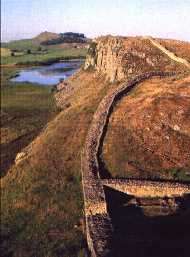
Today, spectacular stretches of the Wall remain over some of
the most rugged countryside to be found in the British Isles.
Glimpses of Roman organization, religion and culture remain in
view along the Wall at the various forts, milecastles, temples,
museums etc. Hadrian's Wall is without doubt the most
prominent and important monument left by the Romans in Britain.
It captures dramatic images of a Britain divided by conflict and
occupation. |