At
the time of the Roman conquest of southern Britain Queen Boudica ruled
the Iceni tribe of East Anglia alongside her husband King
Prasutagus.
Boudica
was a striking looking woman. - "She was very tall, the glance
of her eye most fierce; her voice harsh. A great mass of the reddest
hair fell down to her hips. Her appearance was terrifying." -
Definitely a lady to be noticed!
The trouble started when P
England
has produced many fierce, noble warriors down the ages who have fought
to keep England free, but there was one formidable lady in history whose
name will never be forgotten - Queen Boudica or Boadicea as
she is more commonly called.
rasutagus, hoping to curry favor with the Romans,
made the Roman Emperor Nero co-heir with his daughters to his
considerable kingdom and wealth. He hoped by this ploy, to keep his
kingdom and household free from attack.
But
no! Unfortunately the Roman Governor of Britain at that time was
Suetonius Paulinus who had other ideas on the subject of lands and
property. After Prasutagus's death his lands and household were
plundered by the Roman officers and their slaves.
Not
content with taking all the property and lands, Suetonius had Prasutagus'
widow Boudica publicly flogged and her daughters were raped by Roman
slaves!
Other
Iceni chiefs suffered in a like manner and their families were treated
like slaves.
Not
surprisingly these outrages provoked the Iceni, Trinobantes and other
tribes to rebel against the Romans.
The
Britons at first had great successes. They captured the hated Roman
settlement of Camulodunum (Colchester) and the Roman division there was
routed, the Imperial agent fleeing to Gaul.
Boudica
and her allies gave no quarter in their victories and when Londinium
(London) and Verulamium (St. Albans) were stormed, the defenders fled
and the towns were sacked and burned! The revolting Britons even
desecrated the Roman cemeteries, mutilating statues and breaking
tombstones. Some of these mutilated statues can be seen today in
Colchester Museum.
Finally
Suetonius, who had made a tactical withdrawal (fled) with his
troops into relative safety of the Roman military zone, decided to
challenge Boudica. He assembled an army of 10,000 regulars and
auxiliaries, the backbone of which was made up from the 14th Legion.
The
Roman historian Tacitus in his 'Annals of Rome' gives a very vivid
account of the final battle, which was fought in the Midlands of
England, possibly at place called Mancetter near Nuneaton, in AD61.
Boudica
and her daughters drove round in her chariot to all her tribes before
the battle, exhorting them to be brave. She cried that she was descended
from mighty men but she was fighting as an ordinary person for her lost
freedom, her bruised body and outraged daughters. Perhaps as taunt to
the men in her ranks, it is said that she asked them to consider: 'Win
the battle or perish: that is what I, a woman will do; you men can live
on in slavery if that's what you want.'
 The
Britons attacked crowding in on the Roman defensive line. The order was
given and a volley of several thousand heavy Roman javelins was thrown
into the advancing Britons, followed quickly by a second volley. The
lightly armed Britons must have suffered massive casualties within the
first minutes of the battle. The Romans moved in for the kill, attacking
in tight formation, stabbing with their short swords.
The
Britons attacked crowding in on the Roman defensive line. The order was
given and a volley of several thousand heavy Roman javelins was thrown
into the advancing Britons, followed quickly by a second volley. The
lightly armed Britons must have suffered massive casualties within the
first minutes of the battle. The Romans moved in for the kill, attacking
in tight formation, stabbing with their short swords.
The
Britons now had little chance, with so many of them involved in the
battle it is likely that their massed ranks worked against them by
restricting their movements so they were unable to use their long swords
effectively. To ensure success the Roman cavalry was released which
promptly encircled the enemy and began their slaughter from the rear.
Seemingly mad with blood lust, Tacitus records that 80,000 Britons; men,
women and children, were killed. The Roman losses amounted to 400 dead
with a slightly larger number wounded.
Boudica
was not killed in the battle but took poison rather than be taken alive
by the Romans.
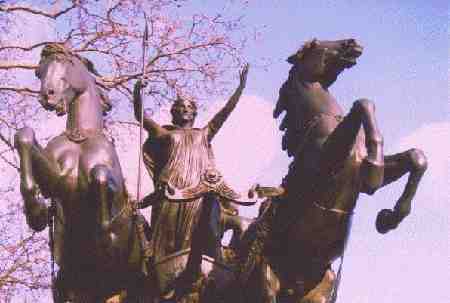
Boudica has secured a special place of her own in British folk history remembered for her courage; The Warrior Queen who fought the might of Rome. And in a way she did get her revenge, as in 1902 a bronze statue of her riding high in her chariot, designed by Thomas Thorneycroft, was placed on the Thames embankment next to the Houses of Parliament in the old Roman capital of Britain, Londinium - The ultimate in Girl Power!